Posts

Why Should we remember 1857? by Dr Mubarak ALI

Image
The year 1857 is an important year in the history of Freedom Struggle against the British rule. Nations write and rewrite their history in order to create historical consciousness among people. The task of historians becomes difficult when the past is distorted and fractured as a result of some dominant political/historical interpretation. In this case, they have to retrieve the lost-past and reconstruct it on the basis of fresh evidence. In 1957, after hundred years of the Great Rebellion, the Indian government not only published number of books on 1857 but organised conferences and seminars to highlight the significance of the uprising.  The great Analysis on 1857 Mutiny :  The two eminent historians differed on the interpretation. Prof. Mujamdar called it ‘sepoy Mutiny’, while Prof. Sen titled his book simply as ‘1857’. With passage of time number of new documents and sources have been published which brought to light new facts about the event which greatl...

difference between CLIMATE and WEATHER?

Image
The difference between weather and climate is a measure of time. Weather is what conditions of the atmosphere are over a short period of time, and climate is how the atmosphere "behaves" over relatively long periods of time. Weather is what you see outside on any particular day. So, for example, it may be  75° degrees  and sunny or it could be  20° degrees  with heavy snow. That’s the weather. Climate is the average of that weather. For example, you can expect snow in the Northeast in January or for it to be hot and humid in the Southeast in July. This is climate. The climate record also includes extreme values such as record high temperatures or record amounts of rainfall. If you’ve ever heard your local weather person say “today we hit a record high for this day,” she is talking about climate records. When scientists talk about climate, they're looking at averages of precipitation, temperature, humidity, sunshine, wind velocity, phenomena such as fog, f...

Planet Earth Now Has A Flag Amazed learn more

Image
Pledging allegiance to the international flag of our planet could become a worldwide practice with this exciting design of a flag for Earth. A new project by Oskar Pernefeldt, a graduate-to-be from Beckmans College of Design in Stockholm, Sweden, sees a new flag for the entire planet emblazoned in scenes around the world – and beyond. The minimalist design of the flag shows seven rings intertwining on a deep-sea-blue background, forming a flower in the flag’s middle. Simple but contemporary, the flag evokes the natural beauty of the Earth. "The blue field represents water which is essential for life – also as the oceans cover most of our planet's surface,” describes Pernefeldt on his website.  “The flower's outer rings form a circle which could be seen as a symbol of Earth as a planet and the blue surface could represent the Universe.” If you can’t imagine such a flag in use, Pernefeldt’s got you covered. In stunning scenarios envisioned...

IQBALISM : ALLAM IQBAL BANNED DOCUMENTARY, Dr annemarie comments on IQBAL and RAHAT tribute

Image
                                      Muhammad Iqbal Muhammad Iqbal (1877-1938) was an Indian Moslem poet and political philosopher. His fame rests on both his poetry and his formulation of ideas that were influential in the creation of Pakistan. Muhammad Iqbal was born in Sialkot, Punjab, probably in 1877, although there is some uncertainty about the year of his birth. He graduated from Government College, Lahore, in 1899 with a master's degree in philosophy. He taught there until 1905, while establishing his reputation as an Urdu poet. During this period his poetry expressed an ardent Indian nationalism, but a marked change came over his views between 1905 and 1908, when he was studying for his doctorate at Cambridge University, visiting German universities, and qualifying as a barrister. ALLAMA IQBAL (BANNED DOCUMENTRY) Dr. Annemarie Schimmel on Allama Muhammad Iqbal ...

KARGIL and KASHMIR: A MILITARY VICTORY TURNING INTO POLITICAL DEFEAT watch special The Outsider With Tim Sebastian

Image
This is a very brief account of what happened in Kargil in 1999. It is meant for those readers who are totally unaware about the broad details of this operation. Ones interested in details about tactical and strategical aspects and lessons learnt etc, are requested to do their own research on the Internet. The Kargil Conflict was an armed conflict between India and Pakistan that took place between May and July 1999 in the Kargil district of Occupied Kashmir and elsewhere along the Line of Control (LOC). The conflict is also referred to as “Operation Koh-e-Paima”. MUSHARAF and JASWANT SINGH talking ABOUT KARGIL dispute in  The Outsider With Tim Sebastian show .    In India, the conflict is also referred to as  Operation Vijay  ( Hindi :  विजय , lit. "Victory") which was the name of the Indian operation to clear the Kargil sector strategic town of kargil  The cause of the conflict was the infiltration of Pakistani s...

HOW MUCH YOU KNOW ABOUT SUN? learn some facts and how it produce heat and much more

Image
The sun is a big ball of hot gases. The gases are converted into energy in the sun's core. The energy moves outward through the interior layers, into the sun's atmosphere, and is released into the solar system as heat and light. Most of the gas — about 72 percent — is hydrogen. Nuclear fusion converts hydrogen into other elements. The sun is also composed of about 26 percent helium and trace amounts of other elements — oxygen, carbon, neon, nitrogen, magnesium, iron and silicon. These elements are created in the sun's core, which makes up 25 percent of the sun. Gravitational forces create tremendous pressure and temperatures in the core. The temperature of the sun in this layer is about 27 million degrees F (15 million degrees C). Hydrogen atoms are compressed and fuse together, creating helium and a lot of energy. This process is called nuclear fusion. WHAT IS SUN video explains everything. Abundance of elements Astronomers who have studied the...

HOW ARE MOUNTAINS FORMED? discover the science of continental drift

Image
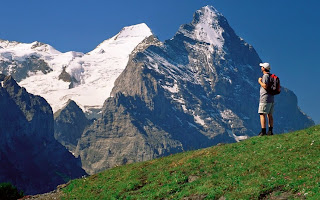
How are mountains formed? Mountains are formed by slow but gigantic movements of the earth's crust (the outer layer of the Earth). The Earth's crust is made up of 6 huge slabs called plates, which fit together like a jigsaw puzzle. When two slabs of the earth's crust smash into each other the land can be pushed upwards, forming mountains. Many of the greatest mountain ranges of the world have formed because of enormous collisions between continents. Watch HOW MOUNTAINS ARE FORMED video made easy?  Mountains form in different ways Sometimes the crust has folded and buckled, sometimes it breaks into huge blocks. In both cases, great areas of land are lifted upwards to form mountains. Other mountains are formed by the earth's crust rising into a dome, or by volcanic activity when the crust cracks open. What different types of Mountains are there? There are five basic kinds of mountains: Fold Mountains (Folded Mountains) Fault-block Mountain...